
Team sports are not just a season on the calendar. In the middle school years, they can become a practical training ground for confidence, character, and leadership.
Middle school has a way of turning everything up. The schedule gets tighter. Friendships get more complicated. Bodies change. Confidence can wobble from one week to the next. And somewhere in the middle of all that, many parents find themselves staring at a familiar question: Is team sports worth it?
The honest answer is yes, if the environment is healthy. Not because every girl needs to become a varsity athlete. Not because a scholarship is the goal. And not because winning is everything. Team sports offer something rare in early adolescence: a structured place to practice teamwork, communication, resilience, accountability, and confidence. Those skills do not stay on the court. They show up later in classrooms, relationships, and careers.

Research has repeatedly linked girls’ sports participation with meaningful personal and developmental benefits, from confidence and wellbeing to leadership skill-building. The Women’s Sports Foundation’s Play to Lead research, for example, frames youth sports as a training ground for leadership traits and experiences that can carry into adulthood. Other research points to mental health advantages associated with team sport participation among youth compared with non-participation. And widely cited executive surveys have found that many women in leadership roles report sports backgrounds and see sports as contributing to their leadership development.
This article is not about guaranteeing a future corner office. It is about giving your daughter a place to build the habits and inner posture of leadership, starting now, when the world around her is changing fast.
Why team sports matter most in the middle school years
In the middle school years, team sports become less about “an activity” and more about identity. This is when girls begin to decide who they are in peer groups, how they handle pressure, and what they do when they feel uncomfortable or uncertain. It is also when many girls are at higher risk of dropping out of sports altogether.
That matters, because the benefits of team sports are not only physical. In early adolescence, a good team environment can create a powerful mix of belonging, structure, and growth experiences that are hard to replicate elsewhere.
Below are five leadership “reps” team sports naturally create.
1) Belonging and shared purpose
Middle school social dynamics can be intense. Team sports can provide a stabilizing counterweight: a group identity, a shared mission, and a routine of showing up together. When girls feel they belong, they are more likely to take healthy risks, try again after mistakes, and stay engaged.
2) Communication under pressure
Team sports are communication training in real time. Calling plays, reading teammates, adjusting roles, giving encouragement, and handling conflict are not abstract lessons. They happen in the moment, with emotion and urgency. Over time, girls learn to speak up, listen, coordinate, and communicate clearly, even when they are nervous.
3) Coachability and standards
A great coach teaches more than technique. A great coach teaches girls how to receive feedback without shutting down. How to separate performance from identity. How to practice with intention.
That ability to accept coaching, apply it, and improve, especially when it is uncomfortable, translates directly to school, internships, first jobs, and leadership roles.
4) Resilience and recovery
Team sports create one of the most important leadership reps of all: recovery.
A mistake happens in public. A play does not go your way. You get benched. You miss the serve. You lose a set. Then you have to decide what to do next.
The leadership skill is not avoiding failure. The skill is learning how to come back, emotionally and behaviorally, and re-engage.
5) Accountability to others
In team sports, girls experience a healthy form of responsibility. They learn what it means to show up because others are counting on them. They learn that effort impacts the group. They learn consistency.
Those habits, reliability, preparation, and follow-through, are quietly powerful predictors of success in many adult settings.
The Sports-to-Leadership Translation Map
One of the simplest ways to understand the long-term value of team sports is to translate common team moments into life skills. The situations change as girls grow older. The internal tools they gain can stay.
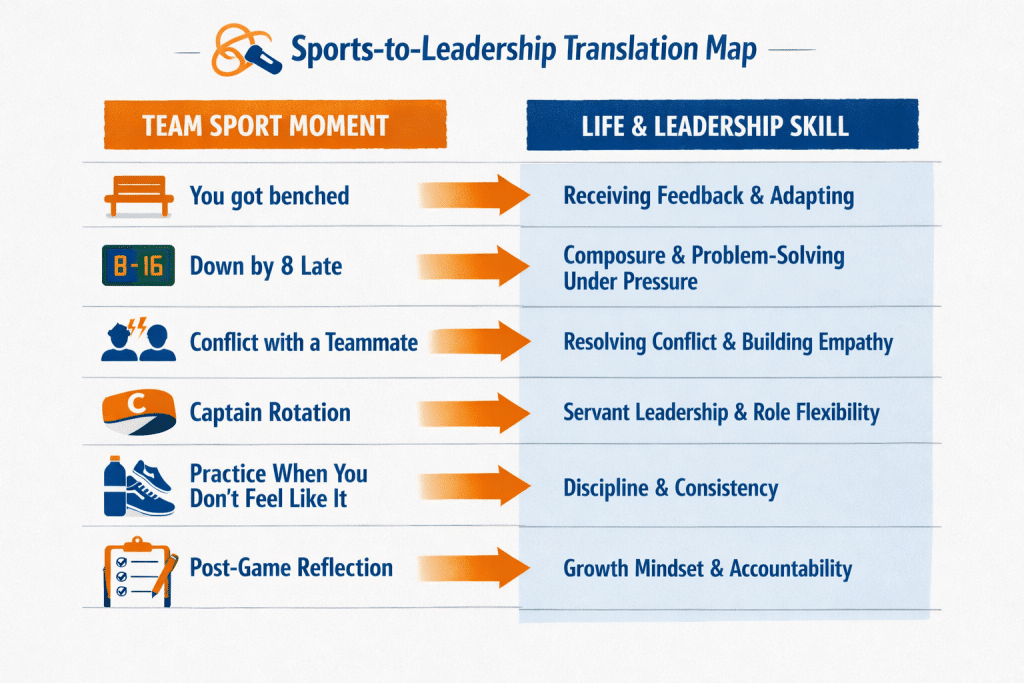
For parents, the point is not to romanticize every hard moment. The point is to notice what your daughter is practicing, over and over, inside a team setting.
What the research says about sports and leadership
It is important to be careful with claims. Sports do not automatically create leaders. And not every sports experience is positive.
But the best research and reporting in this space points to a consistent theme: team sports reliably create conditions where leadership behaviors are practiced.
The Women’s Sports Foundation has published research connecting girls’ and women’s sports participation with leadership development, emphasizing traits such as confidence, resilience, and teamwork. Their Play to Lead work builds a clear narrative: sports experiences provide repeated opportunities to lead, follow, communicate, recover from mistakes, and set goals.
Separately, research on youth mental health has found associations between team sport participation and fewer mental health difficulties compared with not participating. A healthy team can function as a protective space: consistent activity, supportive peers, a shared identity, and adults who guide development.
And in the business world, surveys frequently cited in leadership conversations, including work associated with EY and espnW, have reported that many women in executive roles played sports and attribute aspects of their leadership development to those experiences.
These findings should be treated as correlation rather than a promise. What matters for parents is the mechanism. Team sports can provide structured practice for the exact behaviors we later call leadership.
References
- Women’s Sports Foundation (WSF). Play to Lead (full report PDF, 2024): https://www.womenssportsfoundation.org/wp-content/uploads/2024/09/Play-to-Lead-Report-2024.pdf
- Hoffmann, M.D., et al. “Associations between organized sport participation and mental health difficulties: Data from over 11,000 US children and adolescents.” PLOS ONE (2022). PubMed Central full text: https://pmc.ncbi.nlm.nih.gov/articles/PMC9159603/
- ESPN Press Room. “Female executives say participation in sport helps accelerate leadership and career potential” (EY Women Athletes Business Network + espnW research release, Oct. 9, 2014): https://espnpressroom.com/us/press-releases/2014/10/female-executives-say-participation-in-sport-helps-accelerate-leadership-and-career-potential/
The real risk in the middle school years is not being “too busy.” It’s dropping out.
If you have a daughter in the middle school years, you may have already heard it.
- “She doesn’t feel like she fits in anymore.”
- “She hates how she looks in the uniform.”
- “She says she’s not good enough.”
- “She likes it, but the pressure is too much.”
Girls’ sports participation often declines in early adolescence for reasons that go far beyond motivation. Research and advocacy groups point to factors like social pressure, body image concerns, limited access, cost and logistics, and negative team culture as common drivers.
This is why the question “Should we keep her in team sports?” is not only a scheduling question. It is a development question. The benefits of team sports compound over time. When girls leave early, they can miss the years when confidence, leadership identity, and resilience reps are most needed.
A parent playbook: how to choose a team environment that builds leaders
The most important decision is not the sport. It is the environment.
A healthy team culture can build your daughter up. A harmful culture can shrink her. As a parent, you are not choosing between “sports” and “no sports.” You are choosing the kind of team experience she will have.
Choose culture over status
Look for programs where development is the point. Where effort is praised. Where mistakes are treated as part of learning. Where girls are coached with standards and respect.
Be cautious with environments that rely on fear, humiliation, favoritism, or constant comparison. If your daughter is frequently anxious, dreads practices, or feels consistently unsafe emotionally, those are signals worth taking seriously.
Ask five questions before you register
- How do you define success for this age group?
- How do you handle mistakes during competition?
- How do you rotate roles and build confidence?
- How do you address teammate conflict?
- How do you keep it fun while still competing?
The answers will tell you more than any trophy case.
Protect the joy factor
Fun is not fluff. For adolescents, joy is often what sustains effort.
Your daughter can work hard and still enjoy the process. She can compete and still feel supported. The best team environments challenge girls while helping them feel they belong.
Be a supporter, not a second coach
Parents can unintentionally add pressure by turning every game into a performance review. Instead, reinforce controllables: effort, preparation, teamwork, recovery after mistakes, and consistency.
A simple script can help:
- “I loved watching you compete.”
- “I’m proud of how you responded after that tough moment.”
- “What did you learn today?”
Keep the door open
If one team or one sport is not a fit, that does not have to mean “quitting.” It can mean finding a better environment.
The goal is not a perfect path. The goal is staying in the game long enough for the benefits to compound.
The ROI isn’t a scholarship. It’s who she becomes.
In the middle school years, you are not just enrolling your daughter in a sport. You are enrolling her in a system that can teach her how to show up, communicate, recover, and contribute.
That is the leadership advantage.
Not because sports guarantee high-level success. But because team sports, done well, give girls repeated practice in the behaviors we later praise in confident students, effective leaders, and resilient adults.
Pick a sport. Pick a season. Pick a community that builds her up.
And if she stays with it, the wins will extend far beyond the final whistle.
